Mobile App
Every photo & story captured adds to our living record.
Protecting our natural world through the Valley of Grace's digital twin.
Nature & Technology
A digital twin is an online, real-time copy of a real place, continuously updated by the people who contribute to it. Engineers use digital twins to monitor bridges and power grids. We use ours to monitor the health of the valley: its plants, its animals, its water, its stories, and the people who care for them.
The Valley of Grace has a digital twin called a Nature Realm on the Guardians of Earth platform. The Realm covers about 10,000 hectares, which includes the seven settlements of Ward 2 and the mountains and rivers that connect them. It's already activated and live.
The Realm has a score called the BioScore, and it measures the biocultural health of the valley: how many species have been recorded, how much data has been collected, how good that data is, how many people are contributing, and how much cultural knowledge has been shared by the community. The score goes up every time someone adds something.
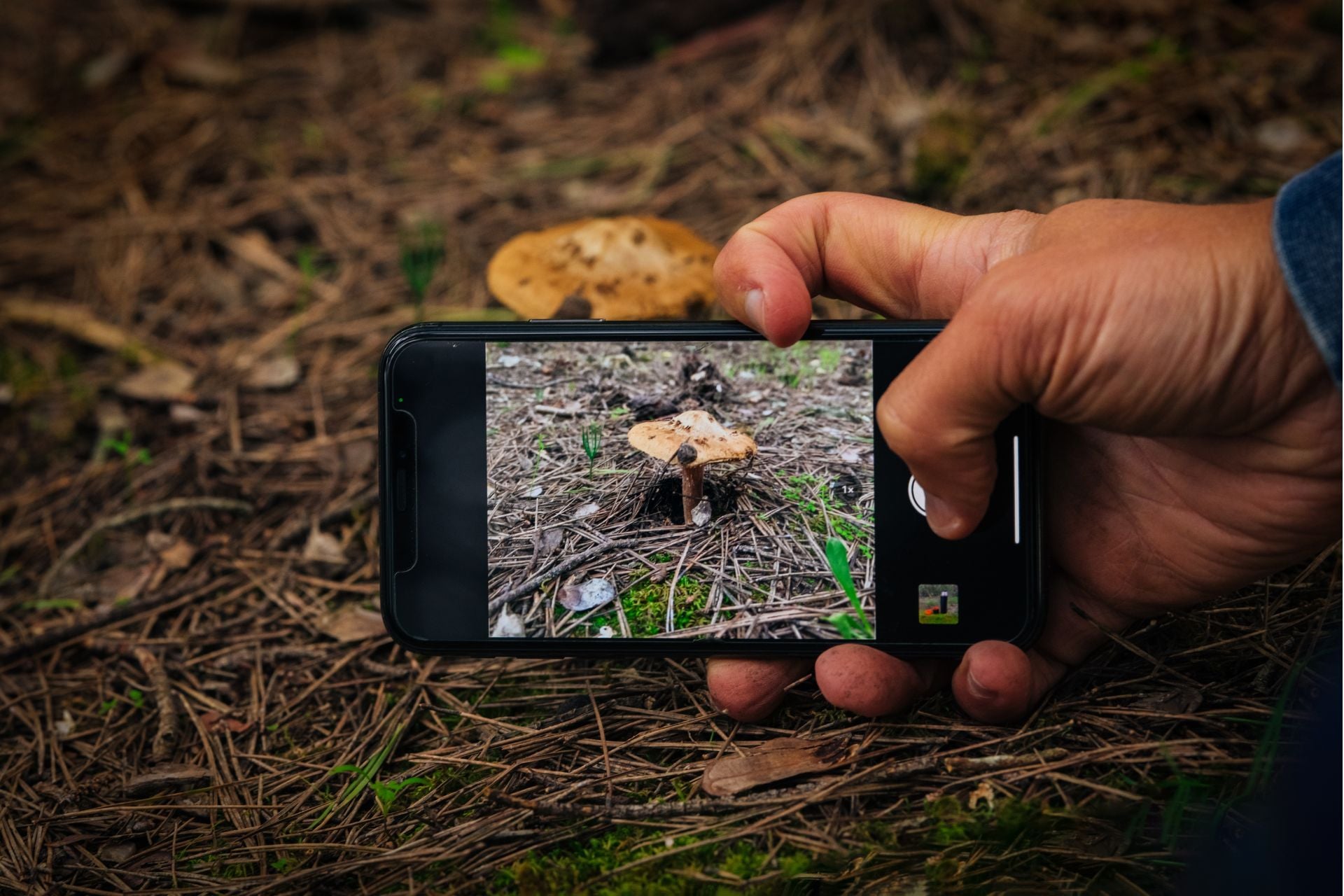
Researchers use visitor photos to track species ranges, detect invasive species, monitor climate impacts, and even discover new species. Image © Kulkova Daria via Shutterstock
Citizen Science
Three ways visitors raise our BioScore.
01
Spot a species
Visitors download an app to their phone. They photograph a bird, a flower, a frog, a mushroom, a leopard, or anything alive and wild within the valley.
The observation is valuable to researchers and it flows into the Global Biodiversity Information Facility and from there into South Africa's national biodiversity records at SANBI.
It also raises the valley's BioScore. Every photograph updates three databases, the visitor's personal score, and becomes a permanent contribution to citizen science.
02
Share a story
Anyone can upload a video, an essay, a photograph, a podcast, a memory, or anything connected to our history. It could be a story about the water mill, or an account of Khoi plant knowledge, or a recording of a church elder describing what Genadendal looked like in the 1960s.
Evidence uploaded by residents with deep connection scores higher than those uploaded by visitors. The community's relationship to the land is the valley's primary asset, and the system recognises that.
03
Play the game
Spirits of the Realms is a free augmented reality game built by Guardians of Earth. It places nature spirits at locations throughout the valley. Visitors discover them by walking, exploring, and submitting species observations along the way. Points earned inside our Nature Realm accumulate and show players on a leaderboard. In the not too distant future, the Genadendal Market will accept these points as payment for purchases.
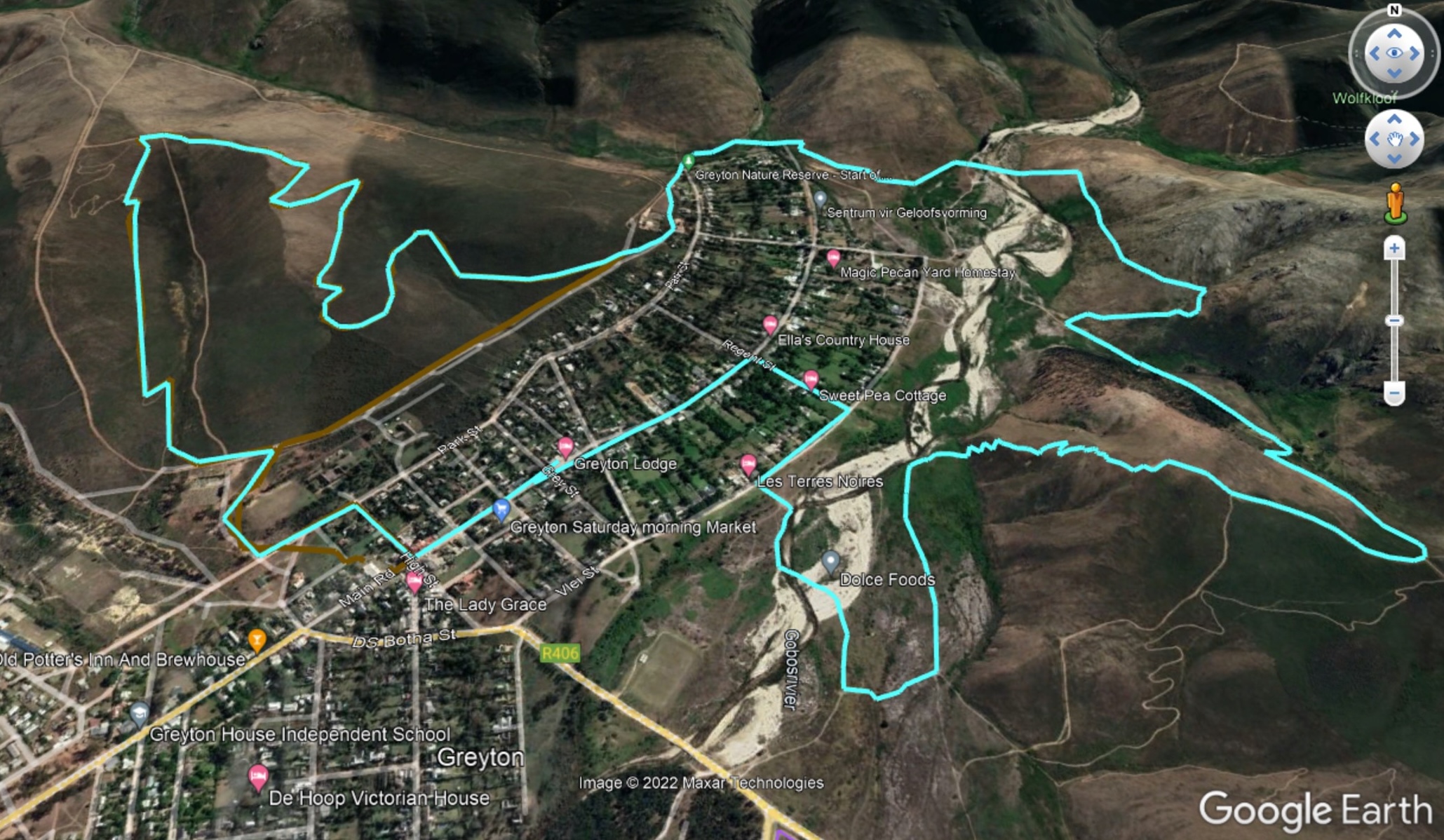
Example of a treasure hunt trail
The treasure hunt
The Business Forum is building a guided discovery trail through its most significant natural, heritage, and producer sites from Bereaville in the west to Greyton in the east. The trail is designed to take more than a single weekend visit to complete.
At natural sites (the future Genadendal food forest, the Greyton Nature Reserve, the Boschmanskloof trailhead, any of the rivers), visitors submit species observations. They photograph a fynbos protea, record a Cape sugarbird, or log an indigenous medicinal plant.
At heritage sites (the Moravian Church complex, the Mission Museum, the printing works, or the water mill), they engage with stories uploaded by local residents: a video about the first teacher training college, or a custodial account of traditional plant knowledge, or a community elder describing the significance of the leiwater system.
At producer sites (Von Geusau Chocolates, the weekend market, Rose Estate, Lismore Wines, the food forest nursery, or any of the emerging small-scale farms), they hear the story of how the product was made. A connection is made between the heritage of the valley and the product itself.
Completing the full trail earns recognition on the Realm leaderboard and rewards at participating outlets.
When the visitor leaves
Once a visitor has contributed to the Valley of Grace Realm, they remain a Guardian after they go home.
They can follow the valley's BioScore over time.
They can amplify stories they found meaningful, raising their visibility and their impact on the leaderboard.
They can purchase BioCultural Units (BCUs) to support the Realm treasury, which funds restoration projects governed by the community.
They can return for the BioQuest competition in April or October, when Realms worldwide compete to see who can grow their score the most in a single month.
They can reorder cooperative products from producers they met on the trail.
Just like in the Babylonstoren example, the Valley of Grace remains in their phone long after we disappear from their rearview mirror.

A visitor accessing the Valley of Grace digital twin from home.
Why a treasure hunt?
What the BioScore unlocks.
01
Community
For the community, it creates a treasury. When people raise the BioScore, they harvest BCUs. A share of those BCUs (between 30 and 51 percent) flows into the Realm's treasury, governed by the community, to fund restoration and development projects within the valley.
02
Schools
For schools, it creates a curriculum. Schools can participate in the global BioQuest competition. A child interviewing a grandparent about local plant knowledge for homework generates the kind of custodial evidence that the BioScore ranks highly. Schoolwork becomes a contribution to the valley's permanent ecological and cultural record.
03
Business
For businesses, it creates destination data. With the BioScore, our valley can report statistics to government, tourism agencies, or corporate partners. The data is independently verifiable and benchmarked against hundreds of other Realms worldwide. The Realm page provides a species map, cultural evidence library, community contributors, and restoration projects, all visible to anyone with a web browser.
04
Corporate partners
For corporate partners, it creates ESG reporting. The BioScore aligns with the Taskforce on Nature-related Financial Disclosures (TNFD) framework. Species data flows through SANBI and the governance structure is documented. A company investing in the valley can report measurable, auditable nature-positive impact.
October 2026 BioQuest
Our first public milestone is the BioQuest competition in October 2026. All registered Realms worldwide are automatically entered. A functioning trail with even a handful of waypoints, supported by school participation and resident species observations, would give the Valley of Grace its first real presence on the global stage.
The valley's biodiversity (fynbos biome, Overberg endemics, riparian corridors, and agricultural heritage) and its cultural depth (the oldest mission station in southern Africa and three centuries of documented history) are assets that few Realms anywhere can match.
Get involved
If you run a business in the valley, you can host a waypoint on the trail. Your shop, your farm, your guesthouse, and your restaurant becomes a stop on a guided experience that brings visitors to your door with a reason to stay longer and spend more. The trail does the marketing, and your offering does the rest to provide every visitor an unforgettable overall experience.
If you represent a church, a school, a civic body, or an NGO/NPO, you hold knowledge and relationships that no technology platform can generate on its own. The BioScore weights local and custodial evidence most heavily. The stories, the history, and the ecological knowledge that your members carry are the valley's most valuable raw material. The platform gives that material a permanent home and a measurable impact.
If you're not sure where you fit, start with one step. Download iNaturalist and create an account in our Nature Realm. Photograph something alive in the valley. Attend the next Business Forum meeting. The structure is designed to accommodate everyone from a guesthouse owner with five minutes to spare to a community organization with a decade of experience.
The October 2026 BioQuest is our first milestone.
See a bright future for Ward 2? Let's build it together.
Creating
abundance for all in the Valley of Grace together.
Ward 2 Business Forum
W2BF represents for-profit and non-profit entities in Genadendal, Greyton, Bereaville, Voorstekraal, Boschmanskloof, Heuwelkroon, and Madiba Park. These settlements make up Ward 2, Theewaterskloof Municipality, Western Cape.
We proudly welcome visitors into our home, and our brand: The Valley of Grace, where garden-centered slow living meets documented community transformation, in a UNESCO-recognized biodiversity hotspot, governed by the people who live there.
Home | About | Invitation | Strategy | Digital Twin | Contact


Copyright 2026. Ward 2 Business Forum. All Rights Reserved.